
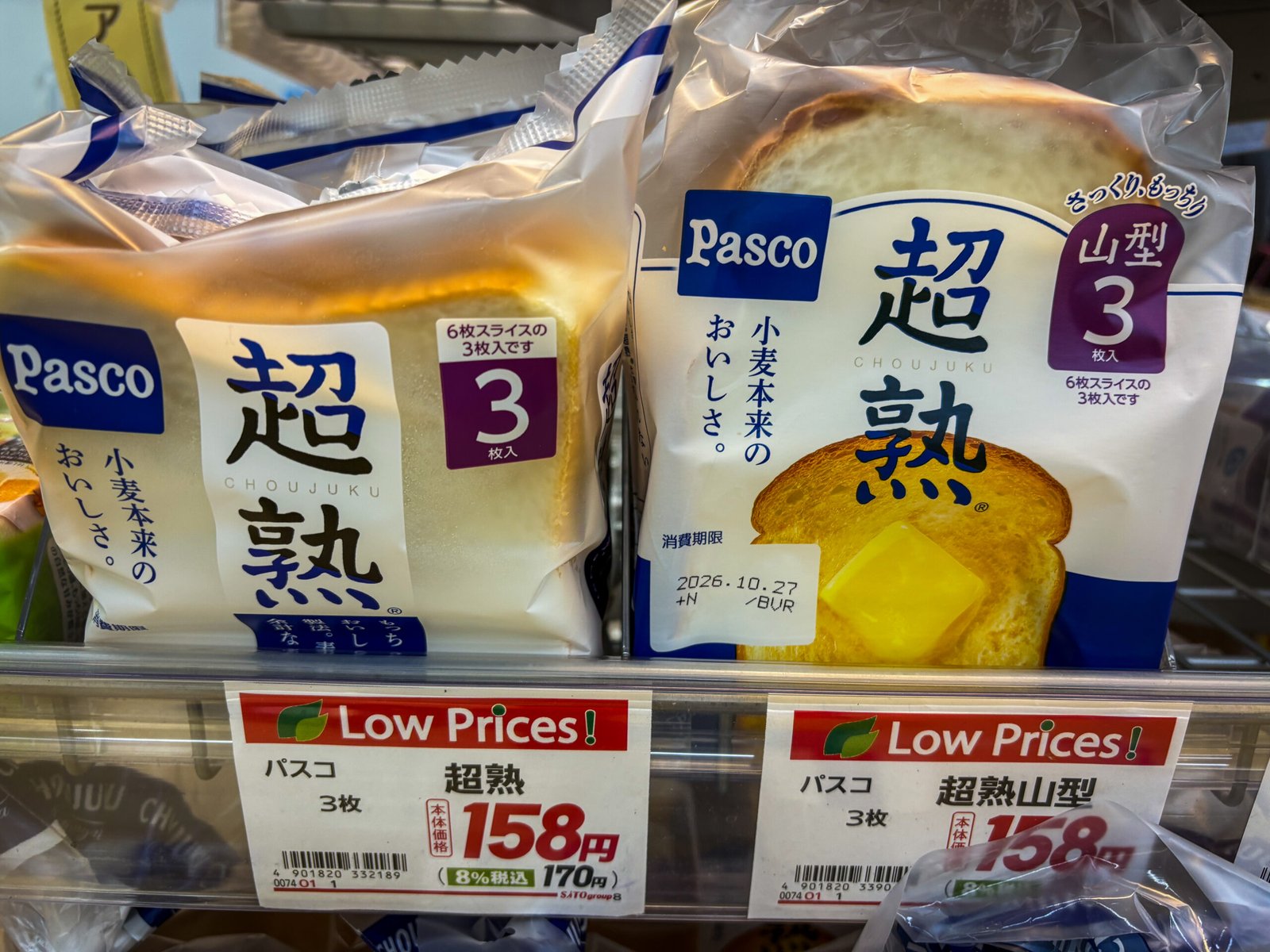
I try to avoid comparing any of my experiences in Japan to my life before moving here, because I want to appreciate Japan on its own terms, without bias. However, very often when I’m with a group of other expatriates from North America or Europe, one comparison arises that leads to a shared conclusion: Japanese bread is terrible. It’s so soft that it requires a very sharp serrated knife to slice it (which is probably why most supermarket bread comes pre-sliced). When chewed it collapses and turns into a little ball of dough. Perhaps worst of all, Japanese people think you can buy a week’s worth of bread from a bakery and put it in the freezer and unthaw it as needed, whereas most of us bread snobs from North America and Europe think day old bread from a bakery is good only for French toast and feeding pigeons.

It’s not as though the Japanese are unsophisticated when it comes to bread. Even our little rural town boasts bakers who were trained abroad and who’ve achieved regional and national fame. When their bread becomes available to buy — always in very limited quantities on particular days and places — people line up, and it invariably sells out. My wife buys it, and we eat it, but to me it’s not quite bread.

There’s even a baker who specializes in bagels, selling her wares once a month at a pop up shop on our street. People who learn I’m from New York — which is of course famous for bagels — often ask me what I think of these local versions. I try to answer honestly: they’re good, but from the perspective of a New Yorker, they’re not bagels at all. I explain that they’re more like a combination of a donut and a muffin, shaped like a bagel, and I tell them that if they want to know what a bagel is, they have to go to New York. However, I know that if they actually went to New York and tried a bagel, they’d be disappointed. They’d say it was too dry, and so hard it tears up the roof of your mouth and nearly breaks your jaw to chew it, and so dense that just putting a bite of it between your teeth feels like a choking hazard (all of which is true, but I love bagels anyway).
As I said, I’m trying to overcome my biases and acquire a taste for all things Japanese, including Japanese bread. The problem is, it seems we humans can’t experience anything without comparing it to something we’ve experienced before. It’s wired in. If you don’t believe it, try this experiment: Take three buckets and line them up in front of you. Fill the bucket on the right with hot water. Fill the bucket on the left with ice cold water. Fill the bucket in the middle with water at room temperature. Then, put your left hand in the bucket on the left, and your right hand in the bucket on the right. Naturally, the left hand will feel cold, and the right hand will feel hot. Then, simultaneously put both hands in the middle bucket: Your left hand will feel hot, and your right hand will feel cold, even though the water temperature is objectively the same. Making subjective comparisons is literally wired in to our nervous systems.
There must be some evolutionary reason for this, but evolutionary advantages are all about passing along our genes, and not about making us happy. It’s like the well-established human bias for negativity: our ancestors are those who mistook a stick lying on the path for a snake, not those who mistook a snake lying on the path for a stick. Praise be to my snake-fearing ancestors, to whom I owe my existence! That said, constantly scanning my environment for the modern day versions of snakes has not served me well in terms of my personal happiness or mental health. Neither will the habit of comparing my experiences in Japan to my experiences elsewhere.
Given the millions of years of evolution that produced the body/mind/energy flow that is me, plus the sixty-plus years of cultural conditioning layered on top, how likely is it I will one day shed my biases and acquire a taste for Japanese bread ? Not very. It’s fairly certain that I’m stuck with a lifelong preference for New York bagels. I suppose there are worse fates. Still, I have faith that whatever I eat is best enjoyed when I’m open to receiving that elusive thing that hides within each bite: a taste beyond compare.
